Public statement by Civil Society Organisations on the occasion of the First Conference on the Transition Beyond Fossil Fuels
Brussels, 27 April 2026
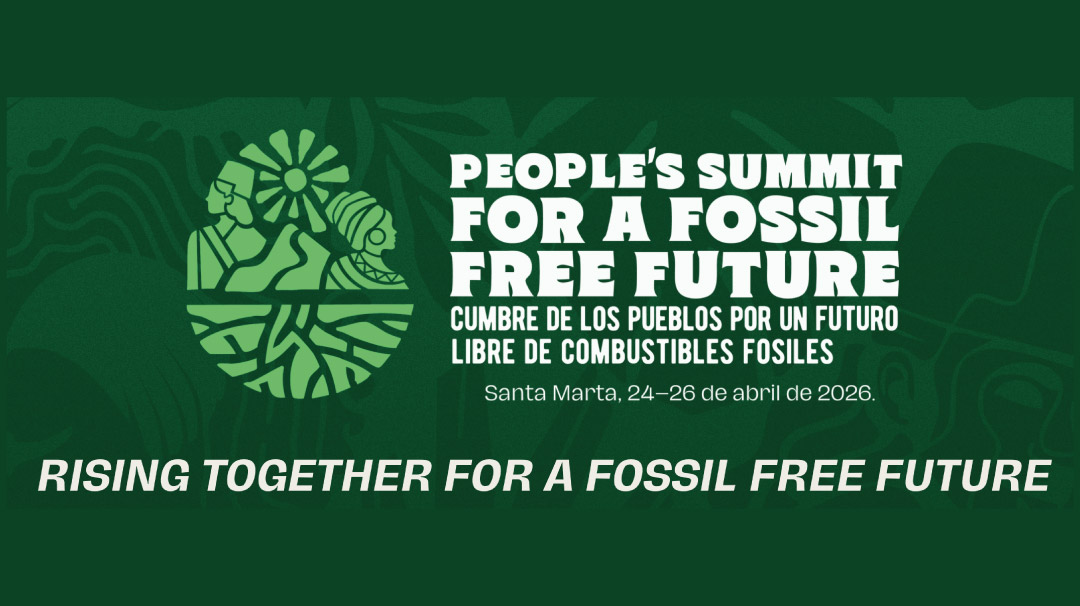
On the occasion of the Conference on the Transition Beyond Fossil Fuels, to be held in the Colombian city of Santa Marta from 24 to 29 April 2026, the undersigned organisations reiterate the need for the EU and Europe to reduce their dependence on fossil fuels and transform their extractive economic relations with other countries globally, with a particular focus on Latin America and, in particular, Colombia.
Colombia, which is co-hosting the conference with the Netherlands, has long been known for exporting raw materials to the Global North, particularly fossil fuels such as coal. Far from generating well-being, this extractivist model has led to multiple human rights violations and serious environmental impacts on the communities living in the vicinity of these projects: forced displacement, restricted access to water and food, health impacts, pollution, labour rights violations, a lack of redress for victims, and violence against human rights and environmental defenders.
In places such as the ‘sacrifice zones’ of La Guajira in Colombia – one of the country’s main coal-producing regions – some of the highest rates of multidimensional poverty and food insecurity in the whole country persist. And despite more than five decades of promises from governments and mining companies, which have linked mining activity to the arrival of ‘development’ and ‘prosperity’ for communities, these benefits have never materialised.
These circumstances, combined with the growing fossil fuel crisis – exacerbated by ongoing geopolitical tensions – make it essential to end global dependence on fossil fuels and join forces to drive a genuinely fair, sustainable energy transition based on equitable trade relations across the globe.
In this context, the distribution of responsibilities and efforts must clearly reflect the fact that the burden of the climate crisis and the damage caused by fossil fuel extraction should fall primarily on European countries, which are among the largest consumers and, consequently, among the biggest emitters of greenhouse gases.
For all these reasons, we call on all countries, and in particular Europe to:
• Replace trade relations based on extractivist models with those grounded in diversified, sustainable and fair economies that drive genuine labour and productive restructuring.
• Establish funds for the comprehensive restoration of territories affected by extractivist economies.
• Ensure the effective participation of affected communities, civil society organisations and trade unions in all projects and decisions that impact their territories, including the processes for the closure of mining operations.
• Ensure that agreements on energy transition benefit communities and do not replicate past schemes and models of extractivism.
Signatories
• Action pro Colombia e. V.
• Broederlijk Delen
• Comité cívico de Derechos Humanos del Meta
• CooperAcció
• Corporación Conciudadanía
• DKA Austria
• Fundación del Sinú
• kolko – Derechos Humanos por Colombia e. V.
• Bischöfliches Hilfswerk Misereor e. V.
• Pax Christi International
• Plataforma Colombiana de Derechos Humanos, Democracia y Desarrollo (PCDHDD)
• Plataforma Suiza Colombia
• Red Europea Oficina Internacional de Derechos Humanos – Acción Colombia OIDHACO
• Red EU-LAT
• Ridhe – Red Internacional de Derechos Humanos Europa
• Solsoc
• Soldepaz Pachakuti
The statement was first published on oidhaco’s webpage:
• English: https://www.oidhaco.org/en/
• Spanish: https://www.oidhaco.org/